لم تُترجم هذه الصفحة بالكامل بعد. يظهر بعض النص أدناه أو كله بلغة English، وهي لغته الأصلية.
Work Is Worship: Naming the Sunday Scaries
Faith at Work
Tom Kang · NewStory Church
Work is not the curse; the ground was cursed, so work is not the same as the curse.
- الواعظ
- Tom Kang
- الكنيسة
- NewStory ChurchNon-DenominationalLos Angeles, United States
- التاريخ
- زمن القراءة
- 10 دقائق
- عدد الكلمات
- 2,049 كلمة
- اللغة
- الإنجليزية
المقاطع الكتابية
الوسوم
الفئات
شخصيات كتابية
الخلاصات
في هذه العظة▾
Work Is Worship: Naming the Sunday Scaries
Do you know the "Sunday scaries"? It usually shows up around four o'clock on Sunday afternoon, right before dinner. Suddenly there is an alarm in your chest, and it is reminding you that Monday is coming. The inbox is already growing, the meetings are starting to pile up, and you can almost see the traffic waiting around the corner. It's only Sunday, and yet you're already dreading the week.
Many of us know this feeling. And notice the timing. That dread always begins on the very day we set apart for public worship. It's as if there is a wall: on one side is Sunday, where we worship, and on the other side is Monday through Friday, sometimes Saturday, where we work.
A Spiritual Severance
Think of the show Severance. The employees of a fictional company undergo a procedure that splits their brain in two. At work they are "innies" who know nothing of the outside world, and at home they are "outies" who remember nothing of the workday. Two people live in one body, and the two never meet. The show is really about how that kind of division hollows a person out.
As I thought about this series, I realized there is a spiritual version of Severance in our culture today. We have a Sunday self who sings, prays, and listens to Scripture. You all look and sound very holy right now. But then there is a Monday self, the one who runs the numbers, manages the classroom, and changes the diapers. That version is not necessarily bad, but it is a different person, and their paths never really cross. I call this the work and worship divide.
As adults, we spend most of our waking hours at work. Roughly 80,000 hours over a lifetime, and many of us work more than 40 hours a week. That is more time than we spend with our families, our children, or at church. So if work consumes so much of our lives, have we ever really thought about what God says about it? Or do we assume he cares very little about how we spend most of our hours, and that he only cares about us showing up on Sunday? That is the question this series will explore.
Where Did Work Come From?
Let's start with a true or false question. Is work part of the curse, a punishment for Adam and Eve's sin? Many of us would say yes, or at least we live as though it is true. We treat work as a sentence to serve until the weekend sets us free.
But look at where work first appears in the Bible. It is in Genesis 2, before the fall and before any sin enters the picture:
When no bush of the field was yet in the land and no small plant of the field had yet sprung up, for the LORD God had not caused it to rain on the land, and there was no man to work the ground.
The world was waiting for a worker, and God made one. Then in verse 15, "The LORD God took the man and put him in the garden of Eden to work it and keep it." The Hebrew word for work here is avodah, and that root appears hundreds of times throughout the Old Testament. Sometimes it means work, as with Adam in the garden. Other times it means to serve, as with priests who serve in the temple. And still other times it means to worship, as when God tells Pharaoh, "Let my people go so that they may serve me."
This is why the line "work is worship" is not just a bold statement but a biblical one. God never divided your Sunday from your Monday. We did. We chose to live with a severance procedure, but God never told us to live that way.
Worship Through Work, Not Worship of Work
A word of caution, especially here in Los Angeles. Scripture says we are to worship God through our work. We are not to worship our work. Some of us don't dread Monday at all; we love it, we live for it. Often that is because we find success there, and we find our security, value, and identity in our job. That may not be worship at all. It can become idolatry.
Blessing Before Assignment
Now look at the pattern in Genesis 1:27-28:
So God created man in his own image, in the image of God he created him; male and female he created them. And God blessed them. And God said to them, "Be fruitful and multiply and fill the earth and subdue it and have dominion over the fish of the sea and over the birds of the heavens and over every living thing that moves on the earth."
Think about how people introduce themselves. The first question is usually "What's your name?" and the second is "What do you do?" Notice how God introduces himself in Genesis 1: he works. He speaks, separates, creates, shapes, and names over six days. Then he makes people in his image.
The order matters. Blessing comes first, assignment second. You do not work to earn God's blessing; you work from God's blessing. But we often reverse the order: if I perform well, then I am worthy; if I accomplish enough, then I will be someone valuable. God says, "No. I blessed you first. Now go do what I have put in front of you." Your identity comes before your assignment. Your worth comes before your work.
When God gives people raw materials and tasks them to make something of them, we see the pattern of ordinary work. The film editor in Burbank who turns twenty hours of footage into a movie that makes you cry is bringing order out of chaos. The nurse tending a body back to health is keeping what God made. The teacher with a room full of restless kids, instilling a love of learning, is being fruitful. The contractor, the barista, and the mom on her third load of laundry are all doing Genesis-type work. Most of us never thought of it as worship, never imagined we could honor, acknowledge, and glorify God through it.
Your job may be secular, but that does not mean it is not sacred. You may think only pastors and missionaries have callings and everyone else just has a LinkedIn profile. That is not how it works. We all have a divine call, and we can all worship through our work.
Hearing From Someone in the Pews
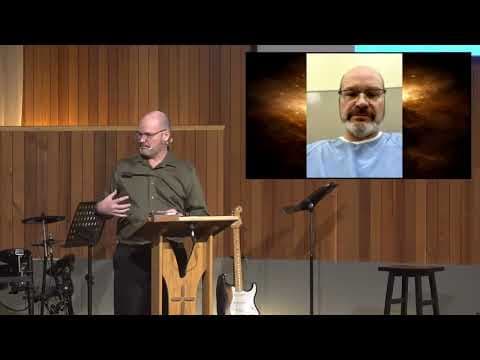
To show that this is not just a pastor's perspective, we heard from Shannon, who worships here every week with her family and carries that worship into her work as a sonographer. She described how people assume ultrasound is all about babies, but she scans livers, legs, and arms, working to give the radiologist a clear picture. She treats every patient the same, whether they come off the street or from a multi-million dollar mansion in Newport Beach.
Shannon traces her work ethic to her parents and especially her mom, who often reminded her: do it unto the Lord. You are not working for man; you are working for the Lord.
Her calling took shape in a painful season. In 2001, she was a stay-at-home mom with two toddlers when she was pregnant with twins. At 23 weeks she was hospitalized in preterm labor, delivered the twins, and lost them. Her hospital experience was not good. She was not treated well, was not given information, and was sent home anemic. Afterward, as she underwent her own ultrasounds, she became curious about how the technology worked, and that curiosity led her into the field.
God has used that loss to give her a spirit of peace and an understanding of what it feels like to grieve. She has prayed with families, given them resources, and helped them know what to expect after a loss. When she scans an older patient with dementia, she may simply hold their hand and pray. When patients pour out their hearts, she stops and asks, "Can I pray for you?" It is life-changing for them and for her.
As Shannon's pastor, I want to point out what she said about her mom. Her mom was quoting Scripture long before I ever preached it, and today we see the fruit of that faithfulness. I also want you to notice where Shannon's calling took shape: in a hospital bed, in the worst week of her life, with caregivers who were not very caring. I believe that God never wastes a hurt. Today Shannon walks into rooms where some people are receiving the best news of their lives and others are receiving the worst. Her worship on Monday is shaped by what God allowed her to walk through on another day.
The Curse Landed on Work, Not on Worth
Work is not the curse. Work got cursed, and those are two very different things. Genesis 3 describes the ground being cursed, and because of that, thorns and thistles now show up in every job: the coworker who takes credit, the client who doesn't pay on time, the layoff email sent at 4:58 p.m. on a Friday.
The curse landed on your work, not on your worth. Losing a job doesn't cancel your calling. Adam still worked after the fall; he just sweated a little more, and so do we.
"Knowing that from the Lord you will receive the inheritance as your reward. You are serving the Lord Christ." (Colossians 3:24, paraphrased in the sermon)
Your Worth Is Not Found in Your Work
The flip side is just as true. If a layoff cannot take your worth away, a promotion cannot give it to you either. A bad review doesn't define you, but neither does a great one. Your worth was never supposed to come from your work. The order matters: blessing first, assignment second. You have already been blessed, and the assignment comes after.
There Is No Job Without Thorns
Many of us are discontent with our current work because it has so many thorns, and we secretly think we need to find a job that doesn't have them. But that job doesn't exist. The real question is not whether you can find work without thorns. The real question is what you do when the thorns come.
What Jesus Changes About Monday Morning
Colossians was written to people who had no exit. Paul addresses slaves, people who could not simply quit. To be clear, Paul is not condoning slavery or telling anyone to stay in an abusive job. But he speaks to people who are stuck, and he reminds them of something important in his word inheritance. Slaves do not inherit anything; only children do. Your earthly boss may treat you like property, but God still calls you his child. He still sees you, loves you, and blesses you. You are serving the Lord Christ.
The Thorns Ended at the Cross
Thorns first appear in Genesis 3 with the curse. They appear again on Christ's head, where they were twisted into a crown and placed on his skull. He took the curse of thorns upon himself and finished the work. He said, "It is finished."
Jesus did not die so that you could become a better worker. He died so that you could stop looking to work to save you, validate you, or define you. That truth frees two kinds of people. For the one who dreads their work, the thorns do not get the last word, because the one who wore them walks with you on Monday morning. For the one who worships their work, you can finally let go and stop exhausting yourself on something that can never give you what only Jesus can give.
Reintegration: One Life, Seven Days
Jesus offers healing for the divided way of living, where a person worships on Sunday and merely survives the rest of the week. What he offers is reintegration, coming back together as one whole person. Not an "audi" who worships one day and an "innie" who works the rest of the week, but one life, seven days, all his.
أُعدّ هذا النص بمساعدة الذكاء الاصطناعي من التسجيل الأصلي، وقد يختلف عن الكلمات المنطوقة. راجع التسجيل قبل الاقتباس. الإبلاغ عن تصحيح
استشهد بهذه العظة
للدروس والمقالات وملاحظات الدراسة. يذكر الواعظ والكنيسة ويربط بالتسجيل الأصلي.