
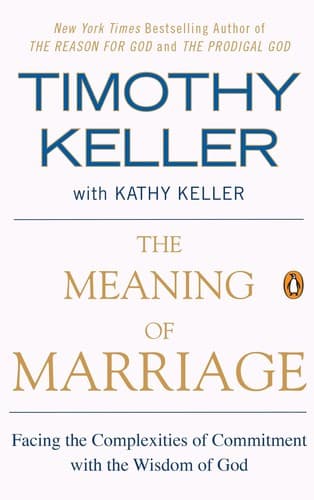
The Meaning of Marriage
Timothy Keller and Kathy Keller
Why it's here: A pastor and his wife set out what marriage is for, drawing on Ephesians 5, with chapters on commitment, love, singleness and sex.
Sermon Registry may earn a small commission if you buy through links marked “Affiliate link”, at no extra cost to you. It never decides what is recommended. How recommendations work
As an Amazon Associate I earn from qualifying purchases.
- ISBN
- 9781594631870
- Publisher
- Riverhead Books
- Language
- English
About this resource
What it’s about
Timothy Keller, writing with Kathy Keller, asks what marriage is for when romance alone cannot sustain it. Drawing especially on Ephesians 5, the book presents marriage as a covenant in which two people learn to love, serve and help one another grow. Its central question concerns the sort of commitment that can endure the discovery that the person you married, and you yourself, are more complicated than you expected.
What to expect, and who it suits
The discussion covers the purpose of marriage, the relation between promise and feeling, friendship, spiritual growth, sex and singleness. Keller connects the ability to forgive and tell the truth with the Christian gospel: receiving grace is meant to change the way a spouse responds to another person's faults. The couple's shared history and pastoral experience give those claims a recognisable setting.
Expect an argument about marriage's meaning with practical implications throughout. The treatment of men and women reflects the Kellers' complementarian reading of Scripture, including differing roles within a marriage. Knowing that perspective helps readers understand the assumptions behind particular applications. The chapters on singleness and marriage also make space for people considering the subject before, or without, being married.
The book suits engaged couples comparing expectations, married couples wanting to revisit the basis of their commitment, and single readers asking how Christian faith understands marriage. Read it together with time for each person to describe their own assumptions before discussing what should change. A useful approach is to take one theme, such as friendship or forgiveness, and name a concrete situation in which it matters. Its greatest value is in giving sustained language for conversations that are often reduced to compatibility, romance or the immediate problem in an argument.