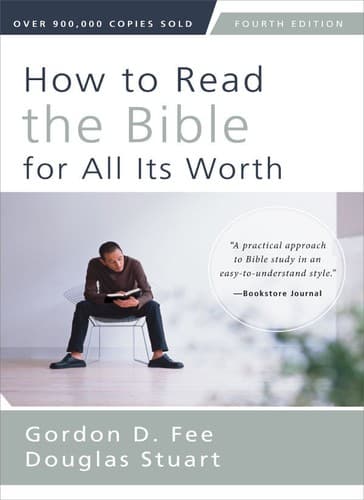
How to Read the Bible for All Its Worth
Gordon D. Fee and Douglas Stuart
Why it's here: A guide to reading each kind of biblical writing on its own terms, from the epistles and narratives to the Psalms and Revelation.
Sermon Registry may earn a small commission if you buy through links marked “Affiliate link”, at no extra cost to you. It never decides what is recommended. How recommendations work
As an Amazon Associate I earn from qualifying purchases.
- ISBN
- 9780310517825
- Publisher
- Zondervan
- Language
- English
About this resource
What it’s about
A letter responding to a church's problems needs to be read differently from a proverb, a lament or a vision. Gordon D. Fee and Douglas Stuart explain why those differences matter and how to work with them. Their starting distinction is between understanding what a passage communicated in its original setting and considering its significance for readers today. The aim is to give ordinary Bible readers a repeatable way to ask better questions of the text.
What to expect, and who it suits
After considering interpretation and the choice of a translation, the book takes major kinds of biblical writing in turn. It covers letters, Old Testament narrative, Acts, Gospels, parables, law, prophets, Psalms, wisdom and Revelation. Each section gives readers a reason to change their reading habits: a story does not automatically command imitation, and a proverb needs to be understood as wisdom expressed in its particular form.
The examples are especially useful when a familiar passage seems easy to apply. They encourage readers to slow down, follow the surrounding argument, identify the original situation and notice what the literary form allows the author to do. The chapter on Acts, for instance, raises the question of when a narrated event establishes a precedent for the church.
This is a practical starting point for Bible-study leaders, new preachers and readers who want to move beyond collecting verses. No knowledge of Hebrew or Greek is required. Read it through to grasp the method, then return to the relevant chapter while studying a passage of your own. The most useful test is whether you can explain how you reached an interpretation and why that reading fits both the passage and the larger section of Scripture.