Esta página aún no se ha traducido por completo. Parte o la totalidad del texto siguiente se muestra en English, su idioma original.
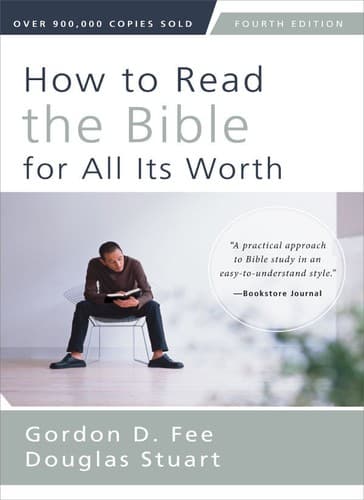
How to Read the Bible for All Its Worth
Gordon D. Fee and Douglas Stuart
Por qué está aquí: A guide to reading each kind of biblical writing on its own terms, from the epistles and narratives to the Psalms and Revelation.
Sermon Registry puede recibir una pequeña comisión si compra mediante enlaces marcados como «Enlace de afiliado», sin coste adicional para usted. Nunca decide qué se recomienda. Cómo se eligen las recomendaciones
As an Amazon Associate I earn from qualifying purchases.
- ISBN
- 9780310517825
- Editorial
- Zondervan
- Idioma
- Inglés
Sobre este recurso
De qué trata
A letter responding to a church's problems needs to be read differently from a proverb, a lament or a vision. Gordon D. Fee and Douglas Stuart explain why those differences matter and how to work with them. Their starting distinction is between understanding what a passage communicated in its original setting and considering its significance for readers today. The aim is to give ordinary Bible readers a repeatable way to ask better questions of the text.
Qué esperar y a quién le conviene
After considering interpretation and the choice of a translation, the book takes major kinds of biblical writing in turn. It covers letters, Old Testament narrative, Acts, Gospels, parables, law, prophets, Psalms, wisdom and Revelation. Each section gives readers a reason to change their reading habits: a story does not automatically command imitation, and a proverb needs to be understood as wisdom expressed in its particular form.
The examples are especially useful when a familiar passage seems easy to apply. They encourage readers to slow down, follow the surrounding argument, identify the original situation and notice what the literary form allows the author to do. The chapter on Acts, for instance, raises the question of when a narrated event establishes a precedent for the church.
This is a practical starting point for Bible-study leaders, new preachers and readers who want to move beyond collecting verses. No knowledge of Hebrew or Greek is required. Read it through to grasp the method, then return to the relevant chapter while studying a passage of your own. The most useful test is whether you can explain how you reached an interpretation and why that reading fits both the passage and the larger section of Scripture.