The living archive is loading.

Part 5 of 6Identity Theft
The Blueprint Bible Study: Identity Series, Part 3
Continue exploring
Connected by scripture or shared themes.
Part 5 of 6Identity Theft
The Blueprint Bible Study: Identity Series, Part 3
Continue exploring
Connected by scripture or shared themes.
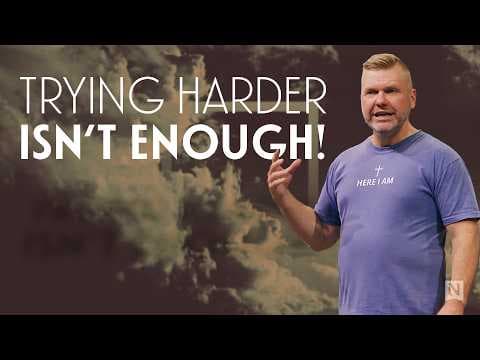
We can't change how we behave without changing how we believe. This is the thesis of our teaching today. Belief actually drives behavior, and behavior exposes what we truly believe. You can't out-behave your belief.
This is why behavior modification doesn't work long-term. When we try to fix behavior first, we get only temporary change. What Scripture promises is a new creation—something entirely different. Long-term behavior change only happens when we change our belief.
James, the half-brother of Jesus, corroborates this in James 2:18 when he says, "I'm going to show you my faith by my works." Our works reveal what we actually believe.
In spiritual spaces, we often try to fix behavior first because we see it as unhealthy or unholy. But the adversary knows this too. He knows that the more we fail at changing behavior through willpower alone, the more cracks appear in the credibility of God's promise of transformation. At some point, your failures become more real to you than God's truth. You start believing your failures more than God's word.
The enemy tries to keep us operating in identity ignorance. This is a critical tactic. Identity ignorance makes us think that where we are is who we are.
When you're confused about your identity, you will live beneath your inheritance. It is possible to live like a spiritual pauper even though you're sitting on a kingdom inheritance. Consider Mephibosheth, the grandson of a king. He was an heir with an inheritance, but he was settled and satisfied living in Lodebar. When David became king, he repositioned Mephibosheth where he should have been. The enemy's strategy is simple: if he can't make you sick, he tries to make you settle.
Mephibosheth was living in a way that wasn't aligned with his lineage. He was a king's grandson living like a beggar. This is what identity ignorance does—it causes us to live beneath who we actually are.
Jesus described the enemy's work in John 10: "The thief comes to steal, kill, and destroy." One of the things he wants to rob us of is a revelation of who we actually are. But Jesus said, "I've come that you may have life."
Here's an important implication: Jesus didn't just come to save lost lives. Jesus came to save the life that was lost. There is a life that God intended to be lived by us as humans, revealed in the garden with Adam, that was lost. Salvation is the restoration of life as God intended.
When we operate in identity ignorance, there's a life that God has designed and prefers that we forfeit because we don't know who we are. God designed it, and God prefers it—but His preference is not always our experience. He preferred Canaan for all of Israel, but only two—Joshua and Caleb—experienced it.
Within the will of God, there are two components we must understand: God has parts of His will that have no conditions (Jesus is returning, period), and parts that have conditions attached. "If my people which are called by my name will humble themselves and pray, seek my face, turn from their wicked ways... then if you're willing and obedient, you shall eat the good of the land" (Isaiah 1:19).
Identity ignorance is actually the symptom, not the sickness. The root is that we've been robbed of a revelation of who we are.
Ignorance doesn't just mean the absence of information. It often means the absence of accurate information. People aren't just uninformed—they're misinformed. This creates what I call ignorant arrogance: people standing strong and loud on things while being completely wrong.
This is particularly dangerous in Christian spaces where teachers aren't discerning doctrine in community. They go to their prayer closets, come back out saying "God gave me a revelation," but they haven't vetted it through Christian community where the holes in their argument could be exposed.
There's an epidemic of biblical illiteracy. People will affirm what's wrong because they don't know what's right. If somebody believes what they say and sounds good, people accept it as truth.
"When you're confused about your identity you will live beneath your inheritance."
This is the danger: the enemy keeps us operating in identity ignorance so we forfeit God's preferred life.
What Paul does in Ephesians, and what God does throughout Scripture, is rewrite the narrative in your mind about your identity so that your behavior can align with who you really are. This is spiritual warfare.
You see this pattern everywhere in Scripture. God tells Abraham he'll be the father of many nations when he's childless. God tells Gideon he's a mighty warrior when he's threshing wheat in a wine press. There's nothing mighty or valiant about what he's doing, yet God declares it.
There's a tactic in cognitive therapy called schema restructuring that helps people rewrite narratives in their minds. It's rooted in neurogenesis—the fascinating reality that while the brain affects the mind (physical damage causes mental effects), the mind also affects the brain. The stories we tell ourselves, our thinking patterns, become hardwired into our brain as our default pattern of thinking.
This completely changes how we read Romans 12: "Be transformed by the renewing of your mind." Part of mind renewal is rewriting the narrative of who we actually are.
This is exactly what Paul is doing in Ephesians. In week one of this series, I spent the entire lesson talking about the greeting—because when Paul greets the saints in Ephesus, it's not just a polite greeting. It's identity formation. He calls sinful, messy, hedonistic, confused individuals "saints."
He's rewriting the narrative because he knows that realigns their behavior. Paul doesn't tell them to walk worthy until chapter four. He spends the previous chapters establishing who they are in Christ. Then when he gets to chapter four, he says, "Walk like it."
In many religious spaces, we do the opposite. We say: walk like it, then you're a saint. What Paul says is: you're a saint now, walk like it. Walk like it until you feel better. Walk like it until things get better. Walk like it until you think better.
You can't just rewrite a narrative in your mind—you must speak it. Because you can never live right if you keep speaking to yourself wrong. We must learn to speak to ourselves rightly, to speak life and positivity over ourselves. Most of our identity comes not just from what we experience, but from what we speak over ourselves based on what we experience.
There's a difference between affirmations and confessions. Confessions are when you come into agreement with what God says about you. This is biblical, not toxic positivity.
When I confess my sin, I'm like, "Now I feel like they deserved everything I gave them, but You said love my enemies. So I'm going to come into agreement with what You say about my behavior." I might feel weak and discouraged, but You said I will be strong in the Lord. So I'm going to come into agreement with what You said.
This is what Paul is trying to do in Ephesians. He's establishing their primary identity: saints.
Paul is establishing their primary identity as saints. This is about to upset some people in religious traditions.
Look at Paul's language. When he speaks of sinner as an identity, he speaks of it in past tense: "who you once were." There's so much emphasis on Christ's work and the redemptive nature of that work. Paul says, "You are not that anymore, even if you struggle with that some."
This is very different from "you ain't nothing but a sinner saved by grace." That's only part of who you are. Here's what Paul says you are:
1. Blessed. God has already spoken favor over your life and deposited every spiritual blessing in Christ in your heavenly account.
2. Chosen. Before the foundation of the world, God deliberately chose you out of a group in which He had options.
3. Predestined. God has determined beforehand the redemptive destiny of those who are in Christ.
4. Adopted. "For he chose us in him before the creation of the world to be holy and blameless in his sight. In love he predestined us for adoption to sonship through Christ Jesus" (Ephesians 4).
We need to understand what "adoption" meant in its original context, not in our modern, sentimental context. In America, adoption is often an act of sentimentality. But in the Roman Empire where Paul was writing, adoption was strategic.
The Greek word means "the placing of a son." It doesn't mean I pick someone because I have pity on them. It means: I pick someone because I see potential in them. There is something they have that I want to be added to my family. I see something in them that can only be actualized and realized if they're in my house.
So when they get into the right house:
They get the protection that comes from being part of the house. They get the provision that comes from being part of the house. They get the privilege that comes with being part of the house and carrying that name.
When Paul says we're adopted, it's not just "God felt sorry for me." It's "There's something in me that God realized could not be actualized until He placed me as a son."
We're no longer just God's creation. We're God's children. "We all God's children" isn't technically true—we're all God's creation. But those of us who have received the Holy Spirit (which Paul calls "the spirit of adoption") have moved from a creature-creator relationship to a father-son relationship. Now I'm a child of God. Now I call Him Abba. And I get His protection, His provision, and His privilege.
Consider the prodigal son. He chose to leave the house, but he also had to choose to return. He left the protection, provision, and privilege. But life made him choose to go back.
Here's what happens far too often: the enemy makes us think we're no longer worthy. The prodigal said, "You can hire me as one of your servants." He didn't know he was still a son. Even though he was in the pig pen, his time there didn't change his status as a son. But it changed the story he was telling himself.
When he got back to the father, the father had to rewrite the narrative. The son thought his behavior had disqualified him from being a son. Many times we think what we've done disqualifies us from who we are in God's eyes. But our actions don't change our identity; they change the story we tell ourselves.
Paul says we're redeemed. "In him we have redemption through his blood" (Ephesians 7).
We need to understand what redemption meant in its original context. The closest cultural metaphor we have today is a pawn shop, but the word was primarily applied in the slave market.
Joseph was sold into slavery and purchased by Potiphar, the captain of Pharaoh's guard. In the marketplace, you might see someone standing on a platform, bound, waiting to be purchased. Their freedom wasn't in their own hands. Their future belonged to whoever had enough to buy them.
Redemption is liberation through the payment of a ransom. This is why Paul calls himself a slave to Jesus: "You bought me. You purchased me."
Paul is saying: I was bound, but you bought me. Redemption describes the moment someone walked into that marketplace to buy someone out—to pay the price that would transfer ownership.
"We were owned by sin. Slaves to it, not just participants in it, slaves to it, under its authority, subject to its impulses and demands. And no amount of willpower or religion or self-improvement could buy you out. The price is too high. But redemption came through his blood."
The cross was not just a demonstration—it was a transaction. "The wage of sin is death. But the gift of God is eternal life." Christ was the currency that was exchanged to free us and to transfer ownership from whatever had us hostage to God.
So whenever something is dominating me, owning me, when I'm in bondage to something, it is trespassing illegally because I've been bought with a price. I don't belong to it. I belong to God.
"Let the redeemed of the Lord say so."
You've been redeemed. I've been redeemed.
But Paul doesn't stop there. He says: "I've been forgiven." "In him we have redemption through his blood, the forgiveness of sins, in accordance with the riches of God's grace that he lavished on us" (Ephesians 7-8).
The word forgiveness means to pardon, release, or dismiss. It was often used in legal or financial contexts to describe the cancellation of a debt or the release of a prisoner.
Notice that Paul puts redemption and forgiveness in the same phrase. They're different things, but putting them together has important implications:
One is about being released from prison. The other is about having your fines paid.
It's possible to be released from prison and still have fines you have to pay. But God says: "I'm not only getting you out of prison. I have taken care of the fine." The gospel solves both problems simultaneously.
The same blood that redeems me, the same blood that unlocks the prison, is the same blood that pays the fine. My debt is paid. I've been set free.
When we talk about the gospel, we must include the full story. Jesus didn't just come to show us that resurrection is possible. When the disciples were upset about His departure, Jesus said, "Let not your heart be troubled... I'm not going to leave you as orphans. Something is coming. There's somebody coming. Another helper is coming. It's better for you if I go."
Jesus kept His word. He said He was getting up, and He said something else was coming down. Part of the good news is that He kept that word too.
The good news is that He got up AND the Holy Spirit came down. Now, because of the Holy Spirit, I can get up too. The gospel is not just His resurrection; it's His resurrection plus the indwelling Holy Spirit that empowers us to live.
"And you were included in Christ when you heard the message of truth, the gospel of your salvation. When you believe, you were marked in him with a seal, the promised Holy Spirit, who is a guarantee or a deposit guaranteeing our inheritance until the redemption of those who are God's possession" (Ephesians 13).
When we think of "seal," we might think of a top on a jar, but that's not what this means. Think of a stamp—a wax stamp.
In the ancient world, when someone was sending a letter from the king, the king would take his signet ring, dip it in wax, and seal that letter. The seal:
God made a claim on your life with the Holy Spirit. This belongs to Me. The Holy Spirit announced God's ownership, established authenticity, and warned everyone that you belong to a particular authority.
Paul also says the Holy Spirit is the "earnest of our inheritance"—a down payment. This word literally means a down payment that legally obligates the payer to complete the full transaction. It's the first installment.
The Holy Spirit is a down payment on a future transaction. He's not the totality of what God has for you. He's God's legally binding deposit—His commitment that what He started, He will finish. What He promised, He will deliver.
The life we have access to in the Holy Spirit now is just a down payment of what life can actually be like:
This letter was written to believers in Ephesians, but it was written for us because we all are in warfare when it comes to narratives about who we are.
What Paul did for believers in Ephesus, what God did for Abram, Gideon, Jacob, and so many others, God wants to do with us: rewrite the narrative and address the identity ignorance that is driving our behavior and robbing us of the spiritual inheritance God wants His people to experience and enjoy.
I knew I was forgiven, but I didn't know all that. I knew I was adopted, but I didn't know it meant all that. I knew I was redeemed. I didn't know it meant all that. I knew I was sealed. I didn't know it meant all that.
And now that I know what it means, I want all that. And I can and I will pursue all that.
We can't change how we behave without changing how we believe. This is the thesis of our teaching today. Belief actually drives behavior, and behavior exposes what we truly believe. You can't out-behave your belief.
This is why behavior modification doesn't work long-term. When we try to fix behavior first, we get only temporary change. What Scripture promises is a new creation—something entirely different. Long-term behavior change only happens when we change our belief.
James, the half-brother of Jesus, corroborates this in James 2:18 when he says, "I'm going to show you my faith by my works." Our works reveal what we actually believe.
In spiritual spaces, we often try to fix behavior first because we see it as unhealthy or unholy. But the adversary knows this too. He knows that the more we fail at changing behavior through willpower alone, the more cracks appear in the credibility of God's promise of transformation. At some point, your failures become more real to you than God's truth. You start believing your failures more than God's word.
The enemy tries to keep us operating in identity ignorance. This is a critical tactic. Identity ignorance makes us think that where we are is who we are.
When you're confused about your identity, you will live beneath your inheritance. It is possible to live like a spiritual pauper even though you're sitting on a kingdom inheritance. Consider Mephibosheth, the grandson of a king. He was an heir with an inheritance, but he was settled and satisfied living in Lodebar. When David became king, he repositioned Mephibosheth where he should have been. The enemy's strategy is simple: if he can't make you sick, he tries to make you settle.
Mephibosheth was living in a way that wasn't aligned with his lineage. He was a king's grandson living like a beggar. This is what identity ignorance does—it causes us to live beneath who we actually are.
Jesus described the enemy's work in John 10: "The thief comes to steal, kill, and destroy." One of the things he wants to rob us of is a revelation of who we actually are. But Jesus said, "I've come that you may have life."
Here's an important implication: Jesus didn't just come to save lost lives. Jesus came to save the life that was lost. There is a life that God intended to be lived by us as humans, revealed in the garden with Adam, that was lost. Salvation is the restoration of life as God intended.
When we operate in identity ignorance, there's a life that God has designed and prefers that we forfeit because we don't know who we are. God designed it, and God prefers it—but His preference is not always our experience. He preferred Canaan for all of Israel, but only two—Joshua and Caleb—experienced it.
Within the will of God, there are two components we must understand: God has parts of His will that have no conditions (Jesus is returning, period), and parts that have conditions attached. "If my people which are called by my name will humble themselves and pray, seek my face, turn from their wicked ways... then if you're willing and obedient, you shall eat the good of the land" (Isaiah 1:19).
Identity ignorance is actually the symptom, not the sickness. The root is that we've been robbed of a revelation of who we are.
Ignorance doesn't just mean the absence of information. It often means the absence of accurate information. People aren't just uninformed—they're misinformed. This creates what I call ignorant arrogance: people standing strong and loud on things while being completely wrong.
This is particularly dangerous in Christian spaces where teachers aren't discerning doctrine in community. They go to their prayer closets, come back out saying "God gave me a revelation," but they haven't vetted it through Christian community where the holes in their argument could be exposed.
There's an epidemic of biblical illiteracy. People will affirm what's wrong because they don't know what's right. If somebody believes what they say and sounds good, people accept it as truth.
"When you're confused about your identity you will live beneath your inheritance."
This is the danger: the enemy keeps us operating in identity ignorance so we forfeit God's preferred life.
What Paul does in Ephesians, and what God does throughout Scripture, is rewrite the narrative in your mind about your identity so that your behavior can align with who you really are. This is spiritual warfare.
You see this pattern everywhere in Scripture. God tells Abraham he'll be the father of many nations when he's childless. God tells Gideon he's a mighty warrior when he's threshing wheat in a wine press. There's nothing mighty or valiant about what he's doing, yet God declares it.
There's a tactic in cognitive therapy called schema restructuring that helps people rewrite narratives in their minds. It's rooted in neurogenesis—the fascinating reality that while the brain affects the mind (physical damage causes mental effects), the mind also affects the brain. The stories we tell ourselves, our thinking patterns, become hardwired into our brain as our default pattern of thinking.
This completely changes how we read Romans 12: "Be transformed by the renewing of your mind." Part of mind renewal is rewriting the narrative of who we actually are.
This is exactly what Paul is doing in Ephesians. In week one of this series, I spent the entire lesson talking about the greeting—because when Paul greets the saints in Ephesus, it's not just a polite greeting. It's identity formation. He calls sinful, messy, hedonistic, confused individuals "saints."
He's rewriting the narrative because he knows that realigns their behavior. Paul doesn't tell them to walk worthy until chapter four. He spends the previous chapters establishing who they are in Christ. Then when he gets to chapter four, he says, "Walk like it."
In many religious spaces, we do the opposite. We say: walk like it, then you're a saint. What Paul says is: you're a saint now, walk like it. Walk like it until you feel better. Walk like it until things get better. Walk like it until you think better.
You can't just rewrite a narrative in your mind—you must speak it. Because you can never live right if you keep speaking to yourself wrong. We must learn to speak to ourselves rightly, to speak life and positivity over ourselves. Most of our identity comes not just from what we experience, but from what we speak over ourselves based on what we experience.
There's a difference between affirmations and confessions. Confessions are when you come into agreement with what God says about you. This is biblical, not toxic positivity.
When I confess my sin, I'm like, "Now I feel like they deserved everything I gave them, but You said love my enemies. So I'm going to come into agreement with what You say about my behavior." I might feel weak and discouraged, but You said I will be strong in the Lord. So I'm going to come into agreement with what You said.
This is what Paul is trying to do in Ephesians. He's establishing their primary identity: saints.
Paul is establishing their primary identity as saints. This is about to upset some people in religious traditions.
Look at Paul's language. When he speaks of sinner as an identity, he speaks of it in past tense: "who you once were." There's so much emphasis on Christ's work and the redemptive nature of that work. Paul says, "You are not that anymore, even if you struggle with that some."
This is very different from "you ain't nothing but a sinner saved by grace." That's only part of who you are. Here's what Paul says you are:
1. Blessed. God has already spoken favor over your life and deposited every spiritual blessing in Christ in your heavenly account.
2. Chosen. Before the foundation of the world, God deliberately chose you out of a group in which He had options.
3. Predestined. God has determined beforehand the redemptive destiny of those who are in Christ.
4. Adopted. "For he chose us in him before the creation of the world to be holy and blameless in his sight. In love he predestined us for adoption to sonship through Christ Jesus" (Ephesians 4).
We need to understand what "adoption" meant in its original context, not in our modern, sentimental context. In America, adoption is often an act of sentimentality. But in the Roman Empire where Paul was writing, adoption was strategic.
The Greek word means "the placing of a son." It doesn't mean I pick someone because I have pity on them. It means: I pick someone because I see potential in them. There is something they have that I want to be added to my family. I see something in them that can only be actualized and realized if they're in my house.
So when they get into the right house:
They get the protection that comes from being part of the house. They get the provision that comes from being part of the house. They get the privilege that comes with being part of the house and carrying that name.
When Paul says we're adopted, it's not just "God felt sorry for me." It's "There's something in me that God realized could not be actualized until He placed me as a son."
We're no longer just God's creation. We're God's children. "We all God's children" isn't technically true—we're all God's creation. But those of us who have received the Holy Spirit (which Paul calls "the spirit of adoption") have moved from a creature-creator relationship to a father-son relationship. Now I'm a child of God. Now I call Him Abba. And I get His protection, His provision, and His privilege.
Consider the prodigal son. He chose to leave the house, but he also had to choose to return. He left the protection, provision, and privilege. But life made him choose to go back.
Here's what happens far too often: the enemy makes us think we're no longer worthy. The prodigal said, "You can hire me as one of your servants." He didn't know he was still a son. Even though he was in the pig pen, his time there didn't change his status as a son. But it changed the story he was telling himself.
When he got back to the father, the father had to rewrite the narrative. The son thought his behavior had disqualified him from being a son. Many times we think what we've done disqualifies us from who we are in God's eyes. But our actions don't change our identity; they change the story we tell ourselves.
Paul says we're redeemed. "In him we have redemption through his blood" (Ephesians 7).
We need to understand what redemption meant in its original context. The closest cultural metaphor we have today is a pawn shop, but the word was primarily applied in the slave market.
Joseph was sold into slavery and purchased by Potiphar, the captain of Pharaoh's guard. In the marketplace, you might see someone standing on a platform, bound, waiting to be purchased. Their freedom wasn't in their own hands. Their future belonged to whoever had enough to buy them.
Redemption is liberation through the payment of a ransom. This is why Paul calls himself a slave to Jesus: "You bought me. You purchased me."
Paul is saying: I was bound, but you bought me. Redemption describes the moment someone walked into that marketplace to buy someone out—to pay the price that would transfer ownership.
"We were owned by sin. Slaves to it, not just participants in it, slaves to it, under its authority, subject to its impulses and demands. And no amount of willpower or religion or self-improvement could buy you out. The price is too high. But redemption came through his blood."
The cross was not just a demonstration—it was a transaction. "The wage of sin is death. But the gift of God is eternal life." Christ was the currency that was exchanged to free us and to transfer ownership from whatever had us hostage to God.
So whenever something is dominating me, owning me, when I'm in bondage to something, it is trespassing illegally because I've been bought with a price. I don't belong to it. I belong to God.
"Let the redeemed of the Lord say so."
You've been redeemed. I've been redeemed.
But Paul doesn't stop there. He says: "I've been forgiven." "In him we have redemption through his blood, the forgiveness of sins, in accordance with the riches of God's grace that he lavished on us" (Ephesians 7-8).
The word forgiveness means to pardon, release, or dismiss. It was often used in legal or financial contexts to describe the cancellation of a debt or the release of a prisoner.
Notice that Paul puts redemption and forgiveness in the same phrase. They're different things, but putting them together has important implications:
One is about being released from prison. The other is about having your fines paid.
It's possible to be released from prison and still have fines you have to pay. But God says: "I'm not only getting you out of prison. I have taken care of the fine." The gospel solves both problems simultaneously.
The same blood that redeems me, the same blood that unlocks the prison, is the same blood that pays the fine. My debt is paid. I've been set free.
When we talk about the gospel, we must include the full story. Jesus didn't just come to show us that resurrection is possible. When the disciples were upset about His departure, Jesus said, "Let not your heart be troubled... I'm not going to leave you as orphans. Something is coming. There's somebody coming. Another helper is coming. It's better for you if I go."
Jesus kept His word. He said He was getting up, and He said something else was coming down. Part of the good news is that He kept that word too.
The good news is that He got up AND the Holy Spirit came down. Now, because of the Holy Spirit, I can get up too. The gospel is not just His resurrection; it's His resurrection plus the indwelling Holy Spirit that empowers us to live.
"And you were included in Christ when you heard the message of truth, the gospel of your salvation. When you believe, you were marked in him with a seal, the promised Holy Spirit, who is a guarantee or a deposit guaranteeing our inheritance until the redemption of those who are God's possession" (Ephesians 13).
When we think of "seal," we might think of a top on a jar, but that's not what this means. Think of a stamp—a wax stamp.
In the ancient world, when someone was sending a letter from the king, the king would take his signet ring, dip it in wax, and seal that letter. The seal:
God made a claim on your life with the Holy Spirit. This belongs to Me. The Holy Spirit announced God's ownership, established authenticity, and warned everyone that you belong to a particular authority.
Paul also says the Holy Spirit is the "earnest of our inheritance"—a down payment. This word literally means a down payment that legally obligates the payer to complete the full transaction. It's the first installment.
The Holy Spirit is a down payment on a future transaction. He's not the totality of what God has for you. He's God's legally binding deposit—His commitment that what He started, He will finish. What He promised, He will deliver.
The life we have access to in the Holy Spirit now is just a down payment of what life can actually be like:
This letter was written to believers in Ephesians, but it was written for us because we all are in warfare when it comes to narratives about who we are.
What Paul did for believers in Ephesus, what God did for Abram, Gideon, Jacob, and so many others, God wants to do with us: rewrite the narrative and address the identity ignorance that is driving our behavior and robbing us of the spiritual inheritance God wants His people to experience and enjoy.
I knew I was forgiven, but I didn't know all that. I knew I was adopted, but I didn't know it meant all that. I knew I was redeemed. I didn't know it meant all that. I knew I was sealed. I didn't know it meant all that.
And now that I know what it means, I want all that. And I can and I will pursue all that.